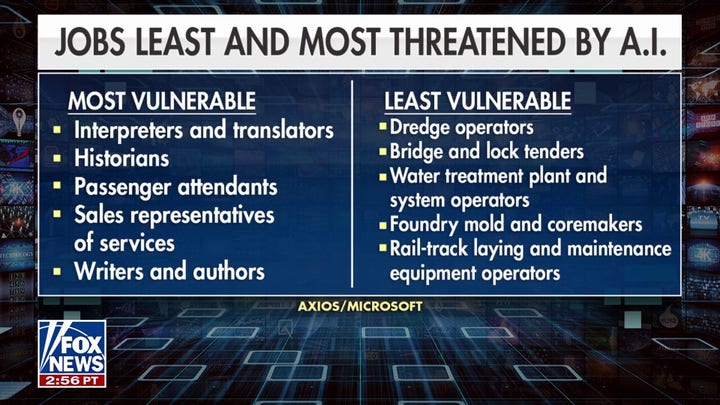
Neither party has put a stake in the ground on the issue that will drive the next presidential election cycle. Artificial intelligence is expected to transform the global economy at a dizzying pace, radically reordering nearly every industry and bringing with it unprecedented disruptions in the labor market.
Nobody is prepared to address what could be the biggest issue of 2028. In a recent earnings call, xAI founder Elon Musk described an exciting era of abundance in which AI and robotics take over labor and Americans enjoy what he calls ‘universal high income.’ But that vision raises more questions than it answers.
Where do people go when entire industries shrink? How do we fulfill our need for meaningful work? Who decides how to distribute this ‘universal high income?’ What is the role of higher education? How much government would we need?
As America approaches its 250th anniversary this summer, we celebrate principles of individual liberty, free markets and limited government that have propelled our prosperity for more than two centuries. Are those principles compatible with Musk’s vision of a post-labor economy featuring universal income distribution?
We have to come to terms with where this AI revolution could take us. In the world of politics, which tends to follow where the winds are blowing, what are the principles that remain timeless? Who do we trust to steer us in these uncertain waters?
Economic incentives are about to shift dramatically. Will free-market Republicans be tempted to become protectionists? Will big government progressives have to embrace deregulation and nuclear energy to protect threatened industries?
I expect every other issue to take a backseat to the looming questions that affect young and old, rich and poor. Traditional political alignments may be turned on their heads. This is too important for us to get it wrong. We can’t just respond reflexively.
AI may offer Americans a generational opportunity to double down on the foundational principles that historically drove our prosperity. But we can expect strong headwinds pushing us toward revisiting the collectivist experiments that have consistently failed in the past.
