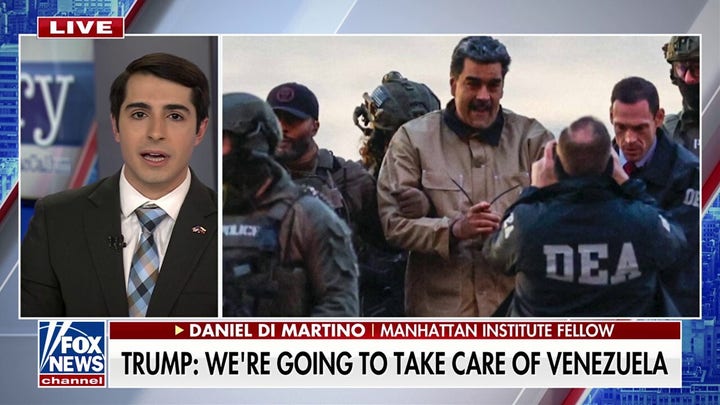
President Donald Trump’s announcement that the United States will temporarily ‘run’ Venezuela following the capture of Nicolás Maduro may prove to be a defining moment for the Western Hemisphere — either a disciplined effort to restore regional stability or the opening chapter of an avoidable, open-ended entanglement.
At his Mar-a-Lago press conference on Saturday, the president stated plainly, ‘We will run the country until such time as we can do a safe, proper and judicious transition.’ He added that members of his national security team standing behind him would oversee the effort and did not rule out ‘boots on the ground.’ Hours later, speaking aboard Air Force One, he sharpened the message further: ‘We’re going to run it, fix it.’
The strategic logic is easy to understand. Venezuela sits atop the world’s largest proven oil reserves and has become a hub for narcotics trafficking, corruption and malign outside influence. The administration’s December 2025 National Security Strategy explicitly embraces what it calls a ‘Trump Corollary’ to the Monroe Doctrine — pledging to deny non-hemispheric competitors such as China, Russia and Iran control over strategically vital assets in the Americas. In that framework, Venezuela is not merely a humanitarian tragedy; it is a test case.
But this is precisely where experience should sober ambition.
The first problem: Who is actually in charge?
A central contradiction now confronts Washington. How does the United States ‘run’ Venezuela when its constitutionally designated vice president, Delcy Rodríguez, has already been sworn in domestically as interim president following Maduro’s removal?
Rodríguez’s claim to authority — backed by Venezuela’s Supreme Tribunal of Justice and regime-loyal institutions — is rejected by Washington as illegitimate. Yet in practical terms, ministries, security forces and regional authorities inside Venezuela remain staffed by officials loyal to the old system. That means the United States is not governing Venezuela in name, law or day-to-day administration — even as presidential rhetoric suggests otherwise.
